Until OneFS 9.16, in-flight encryption of NFS traffic on a PowerScale cluster has historically required Kerberos privacy mode (krb5p). While effective, it does come with an infrastructure cost. A krb5p deployment typically requires a Key Distribution Center (KDC), cross-realm trust if clients and cluster live in different Active Directory forests, reliable forward and reverse DNS, clock synchronization to within five minutes, and a keytab generated, distributed, and kept current for every client that needs access.
OneFS 9.16 introduces native support for encrypting NFS traffic in flight using Transport Layer Security (TLS), implementing RFC 9289, RPC-over-TLS. Built on the same X.509 certificate model that already underpins TLS everywhere else in the data center, it delivers encryption strength equivalent to krb5p without touching a KDC, keytab, or cross-realm trust relationship, and without requiring the NFS authentication flavor in use to change at all. In essence, if you have ever configured a web server certificate, you already understand most of what this feature requires.
There is also no new TCP port configuration required. Conveniently, NFS over TLS runs on the same port 2049 that regular NFS has always used, and TLS-capable (encrypted) and plaintext (unencrypted) connections happily coexist on that same port simultaneously. As such, there are no firewall rule changes required in order to enable this functionality.
Under the hood, an in-band protocol-level upgrade is negotiated before any NFS traffic is exchanged. The client opens a normal TCP connection to port 2049, then issues a NULL RPC carrying the ‘AUTH_TLS’ flavor (flavor value 7) as the very first RPC on that connection. The server replies with a ‘STARTTLS’ verifier, and the two sides immediately negotiate a standard TLS 1.3 handshake, using ALPN (Application-Layer Protocol Negotiation) to identify the application protocol as ‘sunrpc’. Only after that handshake completes does any actual NFS traffic cross the wire, now fully encrypted.
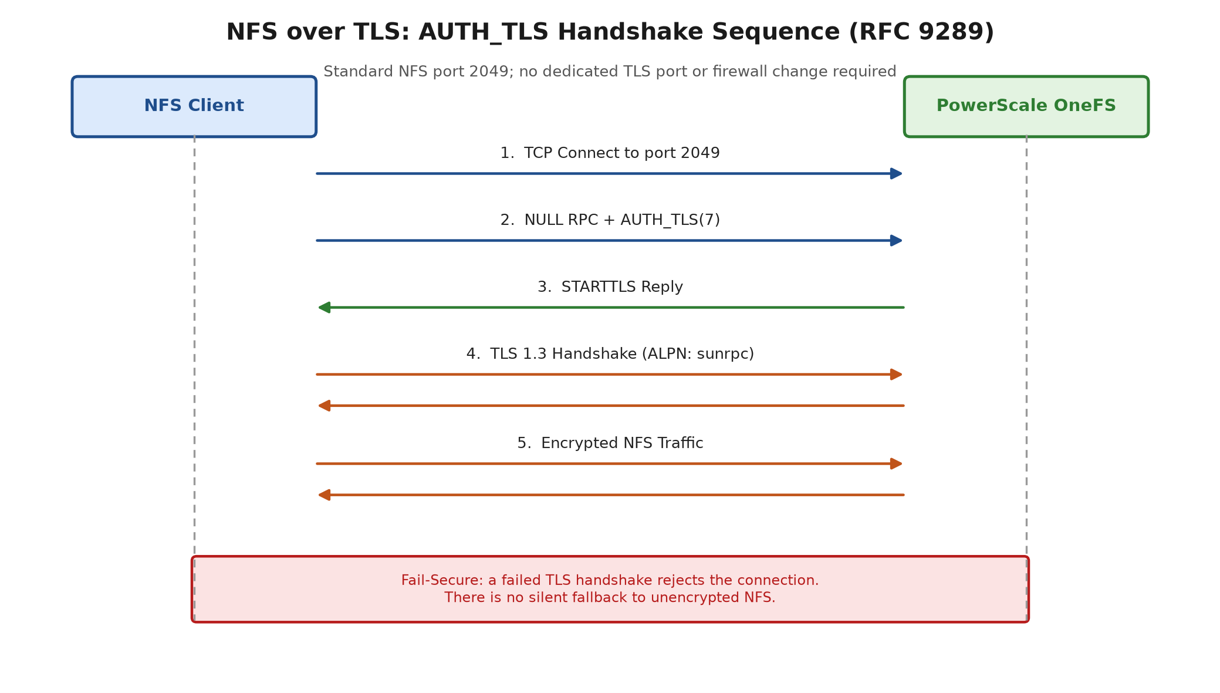
The NFS over TLS design is deliberately fail-secure. If the handshake fails for any reason (i.e. bad certificate, unsupported TLS version, cipher mismatch, etc) the connection is torn down outright. There is no silent fallback to plaintext NFS on that connection, and no mechanism by which a client requesting TLS can quietly end up with an unencrypted session. After a failure, a client that still wants in has to retry again correctly.
OneFS NFS over TLS provides two modes, selected per client mount through the ‘xprtsec’ option:

- Server-Auth TLS (xprtsec=tls) is the lighter-weight option: the cluster presents an X.509 server certificate, the client verifies it, and the session is encrypted, but no client certificate is required. For a lot of deployments, this is the whole story. First, import a server cert, enable the cluster-wide setting, mount with xprtsec=tls, and done in three steps.
- Mutual TLS, or mTLS (xprtsec=mtls), goes further and asks both sides to present and verify certificates, providing cryptographic client authentication to complement the encryption. This is the feature’s real answer to krb5p’s mutual-authentication guarantee, minus the Kerberos machinery, and it comes with OCSP and CRL revocation checking built in, so a compromised or expired client certificate does not quietly keep working.
Crucially, this encryption layer is orthogonal to the NFS authentication flavor sitting inside it. AUTH_SYS keeps working exactly as it always has, carried inside the now-encrypted channel, removing the need to re-architect the identity model in order to obtain transport security.
Policy is enforced at two independent levels, and the effective policy on any given export is the intersection of the two. A cluster-wide setting, ‘nfs_tls_mode’, defines which transport modes the NFS service supports at all, out of ‘none’, ‘tls’, and ‘mtls’. Each export then carries its own ‘xprtsec’ allow-list drawn from that same vocabulary. Neither setting forces a client into anything on its own, so a client still has to request TLS through its mount options. Instead, what these two settings do together is bound what is possible:
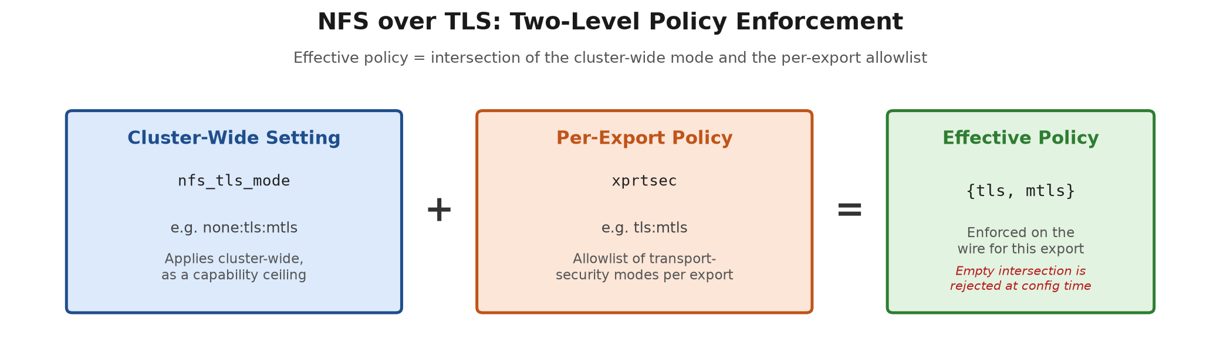
If the intersection of the two settings were to be empty, meaning no client could ever satisfy both the cluster’s capability and the export’s requirement, OneFS would reject the configuration change outright, rather than silently creating an unreachable export. Note that the transport handshake happens before the server knows which export a client is headed for. Because of this, the policy check actually occurs twice. The first check runs at configuration time, comparing the two static settings against each other. The second check runs later, at request time, against the connection’s actual negotiated TLS state. It is this second check that ultimately decides whether a given connection is allowed to touch a given export.
This two-level model allows an administrator to roll TLS out incrementally in a way that was never really available with krb5p: a cluster can be configured to permit TLS alongside plaintext NFS, while individual, sensitive exports are independently configured to require encryption. Mixed TLS and plaintext clients can happily coexist on the same cluster, same port, and in most cases the same export(s), for as long as necessary, with encryption requirements tightened on a per-export basis as clients are upgraded.
NFS over TLS intentionally leverages a cluster’s existing certificate infrastructure rather than introducing a parallel certificate manager. Server certificates come from the ‘system_server’ store that OneFS services already use, and trusted CA certificates for mutual TLS reside in the ‘system_ca’ store. A valid server certificate just needs a Subject Alternative Name matching the hostname or address the client expects.
Multiple server certificates can coexist in the store, with the correct one selected via SNI based on the client’s requested hostname, which maps naturally onto SmartConnect zone names without any extra per-zone certificate configuration. Certificate rotation is handled cleanly too. New certificates are auto-detected within ten minutes, or immediately if an NFS refresh is triggered manually, and the swap is atomic. Existing TLS sessions keep using whatever certificate context they already negotiated; only new connections pick up the refreshed material. A CELOG alert is fired as an expiring certificate approaches its default one-month warning threshold, which is configurable if more runway is desired or required.
TLS 1.3 is the baseline, with TLS 1.2 available only as an explicit administrator opt-in for compatibility, and TLS 1.1 and earlier are unconditionally rejected with no exceptions. The default policy sticks to ECDHE-only cipher suites for Perfect Forward Secrecy, and OneFS’s FIPS 140-2 mode automatically strips out any non-FIPS-validated algorithm from the negotiable set (with CHACHA20-POLY1305 typically being the most noticeable absentee), and with no separate NFS-specific FIPS configuration settings.
Access control gets its own dedicated privilege, ‘ISI_PRIV_NFS_TLS’, required on top of the normal NFS settings or export privileges for anyone changing TLS configuration; reading the current configuration stays available to ordinary NFS operators. Private key material is treated as exactly that: it is not permitted to show up in logs, diagnostics, or core dumps under any circumstances.
On the client side, the prerequisites are a Linux kernel 6.5 or later with the ‘tlshd’ handshake daemon installed and running, plus the server’s CA certificate uploaded to the client’s trust store. An older kernel is a hard blocker, since RPC-over-TLS support has to exist in the kernel’s NFS client itself.
OneFS has long supported in-flight NFS encryption through Kerberos’s privacy mode, krb5p, which combines strong, mutually authenticated encryption with the broader Kerberos identity infrastructure. NFS over TLS is not intended to replace krb5p in every deployment, but provides an alternative encryption mechanism with a substantially different operational profile. The two mechanisms differ chiefly in the infrastructure they depend on and in how encryption relates to client authentication.
| Aspect | Kerberos (krb5p) | NFS over TLS |
| Required infrastructure | Key Distribution Center, cross-realm trusts if multiple domains are involved, synchronized clocks across all participants, and a keytab provisioned to every client. | An imported X.509 server certificate (and, for mutual TLS, client certificates). No KDC, keytabs, or cross-realm trust is required. |
| Relationship between encryption and authentication | Encryption is tied to the selected authentication flavor; krb5p cannot be used without the full Kerberos authentication stack. | Encryption is orthogonal to the authentication flavor in use and functions alongside AUTH_SYS and any supported NFS version. |
| Client setup complexity | Multi-component deployment; every client requires a provisioned keytab and correct realm configuration. | Three-step setup: import the server certificate, enable TLS on the cluster, and mount with the appropriate xprtsec option. |
| Operational resilience | Kerberos ticket expiry can cause NFS I/O failures if ticket renewal is disrupted or a client’s clock drifts out of tolerance. | The TLS session persists independently of any ticket lifecycle; certificates can be hot-reloaded with zero session downtime. |
| Automation and orchestration | Limited native automation; keytab distribution typically requires external tooling. | Full Platform API (pAPI v27) coverage for both cluster-wide and per-export settings, suited to programmatic configuration management. |
| Mutual authentication | Native via the Kerberos ticket exchange. | Available via Mutual TLS (xprtsec=mtls), using X.509 client certificates with built-in OCSP/CRL revocation checking in place of ticket-based identity. |
| Identity granularity | Ties encryption to a specific, centrally managed Kerberos principal per user or per client. | Ties encryption to a certificate-based client or server identity; per-user identity, where required, is still provided by the underlying NFS authentication flavor (for example AUTH_SYS or RPCSEC_GSS), independent of the TLS layer. |
Kerberized NFS typically remains the appropriate choice when an organization already operates a mature Active Directory or MIT Kerberos infrastructure and requires per-user, centrally managed authentication integrated with that identity infrastructure, not merely transport encryption. Environments with an existing, well-maintained keytab distribution process, a regulatory or internal security requirement specifically mandating Kerberos-based authentication, or a need for encryption to be bound to a specific, auditable Kerberos principal per client or user are best served by krb5p. Kerberos is also the appropriate choice where NFSv4 ACL enforcement and identity mapping already depend on an established Kerberos realm, since krb5p integrates directly into that same authentication path without introducing a second, parallel identity mechanism.
Conversely, NFS over TLS is the appropriate choice when the primary requirement is in-flight encryption itself, rather than a specific authentication model. This is particularly true for environments without an existing Kerberos deployment, where standing up a KDC, managing cross-realm trust, and distributing keytabs to every client would represent a disproportionate operational burden relative to the encryption requirement being addressed. NFS over TLS is also the preferred option in several other situations. If certificate-based infrastructure is already in place, or preferred over Kerberos for other services, NFS over TLS fits naturally. It also works well when clients cannot reliably keep their clocks synchronized, since Kerberos depends on tight clock synchronization to function. Another good fit is a phased rollout: encryption can be enabled incrementally across a mixed client population without disrupting existing AUTH_SYS-based exports. Finally, NFS over TLS is the better choice when automating the configuration of transport security via the OneFS platform API (pAPI) is a priority. Because NFS over TLS can be deployed with server-only authentication, it additionally provides a materially lower barrier to adopting in-flight encryption at all for environments that do not require the mutual, per-client authentication guarantee Kerberos provides.
It’s worth noting that the two mechanisms are not mutually exclusive at the cluster level, though a given export’s effective transport-security and authentication configuration should be deliberately chosen rather than combined by default. An organization may operate krb5p on exports tied to an existing Kerberos-integrated identity model while adopting NFS over TLS on exports or client populations for which standing up Kerberos access is impractical, using the per-export policy model described above to apply the appropriate transport-security requirement independently on each export.
In summary, NFS over TLS is not trying to replace Kerberized NFS everywhere. krb5p still has a place when centralized identity is the goal, as opposed to just an encrypted wire. What this new functionality does is remove encryption as a reason to deploy Kerberos infrastructure that is not otherwise needed. An NFS in-flight encryption mandate can now be accomplished with a certificate and a mount option, gradually rolled out export-by-export, while leaving the rest of the server fleet untouched until they are ready to join.
In the next article in this series, we will walk through the full set of CLI commands, mount examples, and troubleshooting steps required to put this into production.