ObjectScale 4.4 and X7700 Platform

Hot off the press comes ObjectScale version 4.4 – a significant release of Dell’s enterprise-grade object storage platform and a key component of the Dell AI Data Platform. ObjectScale 4.4 builds on the foundation laid by earlier releases, delivering broad improvements across performance, security, observability, networking, and licensing that are engineered to meet the evolving demands of AI-driven and cloud-native workloads. Version 4.4 also arrives alongside the new Dell ObjectScale X7700, the ultra-dense HDD storage engine of the Dell AI Data Platform, whose launch highlights are summarized later in this article.

This release is available as a software upgrade for existing ObjectScale environments. The core new customer-facing features and capabilities introduced in ObjectScale 4.4 include:

Performance and Storage Efficiency

ObjectScale 4.4 compacts data indices to improve garbage collection (GC) throughput, enabling faster reclamation of deleted capacity and reducing the operational overhead associated with large-scale object churn. This release also extends support for large object storage workloads, broadening the platform’s applicability for AI training datasets, media archives, and other use cases characterized by very large individual objects.

Targeted performance tuning for Big AI workloads includes shared memory (SHM) refactoring to reduce contention and improve throughput under heavy parallel data access patterns typical of model training and inference pipelines. These optimizations are designed to complement ObjectScale’s role in the Dell AI Data Platform, ensuring that storage I/O does not become a bottleneck for GPU-intensive workloads.

S3 object listing operations now benefit from prefetching, reducing latency when enumerating large buckets. This improvement is particularly impactful for AI data pipelines and analytics workflows that iterate over millions of objects as part of data ingestion or cataloging processes.

Metadata journal garbage collection is now enabled by default in ObjectScale 4.4, improving storage efficiency and reducing administrative overhead by ensuring that metadata journal data is reclaimed automatically without manual intervention. Retention policies have also been optimized to reduce configuration complexity and improve long-term cluster hygiene in geo-replicated environments.

Capacity metrics reporting has been enhanced for greater accuracy, particularly for chunked and geo-replicated data where previous releases could undercount or misrepresent consumed capacity in the dashboard. A related fix corrects inaccurate UI report data for geo-replication configurations, giving administrators a more reliable view of storage utilization across multi-site deployments.

Networking and Connectivity

ObjectScale 4.4 includes S3 over RDMA, using the RoCE v2 (RDMA over Converged Ethernet version 2) protocol, and delivering significantly lower latency and higher throughput for object I/O compared to standard TCP-based S3. This capability is targeted at performance-intensive workloads such as AI/ML training, high-performance analytics, and large-scale data ingest where network latency is a bottleneck.

Enabling S3 on RDMA requires a compatible lossless Ethernet fabric configured with Priority Flow Control (PFC), Explicit Congestion Notification (ECN), and appropriate QoS settings. Note that this feature is disabled by default and must be enabled by engineering on a case-by-case basis while NVIDIA driver certification is completed.

ObjectScale 4.4 introduces load balancer support for Sonic switches, enabling improved traffic distribution across network paths in software-defined and open-networking deployments. This enhancement provides greater flexibility in network architecture design and supports higher aggregate throughput for environments using Sonic-based switching fabrics.

The connectivity framework introduces two new automated behaviors in 4.4: a daily cluster topology transmission to the Dell connectivity portal in AST format, and an hourly heartbeat and connection test. These additions improve proactive monitoring visibility and support faster issue detection and resolution by Dell support teams. The product type on the connectivity portal for key and PIN generation remains “Elastic Cloud Storage Gateway.”

ObjectScale software-defined deployments now support single NIC configurations, including both single-port and dual-port single NIC topologies. This reduces the hardware footprint and simplifies cabling for software-defined environments. Note that this capability is Request for Price Quotation (RPQ)-only for the 4.4 release and must be scoped and approved by the product group prior to deployment.

Security and Platform Hardening

ObjectScale 4.4 introduces a new platform hardening capability that substantially reduces the OS-level attack surface by transitioning the deny list for Object Storage services (OBS) to an allow-list model. When enabled, the escalation tool requires a password configured by the administrator via the UI; the platform internally combines this password with the node service tag using PBKDF2 key derivation, which is entirely transparent to the end user.

Platform hardening is disabled by default in ObjectScale 4.4 for both fresh installs and upgrades, and must be explicitly enabled via the UI or API with an escalation password. It is important to note that this feature is distinct from STIG hardening, which is not included in the 4.4 release.

Root CA rotation for ECS service-level communications is now fully automated in ObjectScale 4.4, eliminating the need for manual tracking and intervention before certificate expiry. In prior releases, administrators were responsible for proactively monitoring and rotating the root CA before it expired. This automation removes a significant operational risk and reduces the burden on storage administrators managing large or distributed ObjectScale environments.

Two combined security capabilities address elevated container privilege mode exposure within the ObjectScale container runtime. These changes reduce the risk associated with privileged containers by enforcing stricter privilege boundaries, contributing to a more secure and defensible platform posture.

The UI’s backend-for-frontend (BFF) layer has been upgraded and rewritten to address security vulnerabilities in the prior implementation. This update modernizes the communication layer between the management UI and backend services, incorporating current security best practices and reducing the exploitable surface area of the management interface.

Observability and Operations

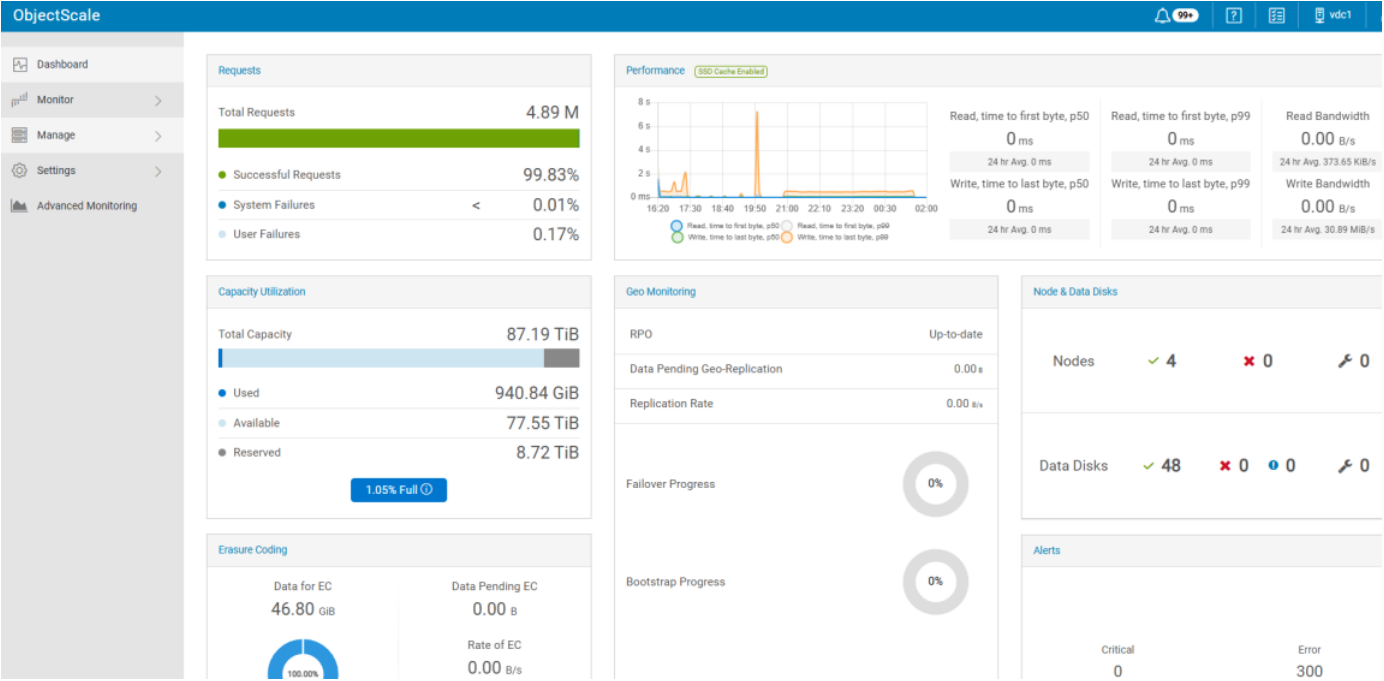
The ObjectScale management UI has received a comprehensive visual refresh in version 4.4, delivering a modernized design and improved user experience across dashboards, configuration workflows, and status views. The updated interface aligns with current Dell design standards and aims to reduce the time administrators spend navigating the management plane.

ObjectScale 4.4 empowers administrators to self-execute pre-upgrade health checks without engaging Dell Professional Services. Using a service orchestrator container (Stargate) available exclusively from 4.4 onwards, customers can trigger health checks via REST API calls before scheduling a maintenance window. The checks validate all current pre-upgrade conditions, including firmware versions and system readiness, helping to surface potential issues early and reduce maintenance window duration.

Documentation for this feature will be included in the ObjectScale Admin Guide. The capability is available only on clusters running ObjectScale 4.4 or later.

ObjectScale 4.4 introduces native Kafka-based event notification support, enabling external systems to consume ObjectScale events – such as object creation, deletion, or policy changes – via Kafka topics. This complements existing webhook-based notifications and is particularly valuable for organizations that have standardized on Kafka as their event streaming backbone for data pipelines and event-driven applications.

An S3 request throttler is introduced in ObjectScale 4.4 as an initial MVP capability, allowing administrators to apply rate limits to S3 operations to prevent any single tenant, application, or workload from exhausting cluster resources. This provides a foundational quality-of-service control mechanism that will be expanded in future releases.

ObjectScale 4.4 delivers S3 Tables at general availability, providing native Apache Iceberg support directly within the platform. Analytics and AI workloads can query and operate on tabular data in place, eliminating the need to move or copy data into a separate analytics engine. A complementary S3 Tables reporting capability surfaces structured visibility into S3 table utilization and access patterns within the ObjectScale management layer, with richer analytics to follow in subsequent releases.

The hashing algorithm underlying ObjectScale’s metering subsystem has been redesigned to improve accuracy and performance of usage data collection. This change ensures that consumption reporting is more precise and scales more efficiently as cluster size and object count grow, which is increasingly important in multi-tenant and pay-per-use licensing scenarios.

Licensing

Dynamic licensing in ObjectScale 4.4 adds Multi-License Aggregation Group (Multi-LAG) support, allowing administrators to manage and aggregate multiple license groups through a unified workflow. Accompanying UI enhancements provide clearer visibility into LAG composition and licensing status, reducing administrative complexity for large or multi-tenant deployments.

ObjectScale 4.4 extends dynamic licensing to better support Transformational License Agreement (TLA) customers. TLA customers – typically software-defined deployments – select a TLA checkbox during SCG configuration, which triggers a dedicated dynamic licensing registration workflow. Without this selection, the system would attempt standard registration, which requires hardware device service tags (DSTs) not present in software-defined environments.

The SCG configuration UI and documentation have been reviewed and updated to consistently use the correct term “Transformational License Agreement” throughout, resolving prior inconsistencies between screens.

For environments where ObjectScale cannot maintain continuous connectivity to the Dell licensing portal, offline compliance reporting provides a mechanism for periodic compliance validation and evidence generation. This is particularly relevant for air-gapped or intermittently connected deployments that must still satisfy licensing obligations.

Hardware Platform Additions

ObjectScale 4.4 qualifies two new drive configurations, expanding the storage density options available to customers:

  • 61 TB Self-Encrypting Drive (SED) on XF960: Qualifies the 61 TB SED for the XF960 all-flash appliance, delivering higher all-flash storage density while maintaining full data-at-rest encryption and security. No user behavior changes are required.
  • 122 TB and 245 TB Drive Support (software-defined): Qualifies high-density 122 TB and 245 TB drives for ObjectScale software-defined deployments, enabling greater storage efficiency with fewer servers and a lower datacenter footprint. No user behavior changes are required.

ObjectScale 4.4 also introduces software delivery support for the X7700 platform (single chassis, 102 drives). Dual chassis qualification is in progress and will be released in a subsequent update. For ObjectScale software-defined deployments on the 7725XD platform, single NIC support (RPQ) is now available as described above.

ObjectScale X7700 Platform

ObjectScale 4.4 launches alongside the new Dell ObjectScale X7700, the ultra-dense HDD object storage engine and dense bulk tier of the Dell AI Data Platform.

Built on a disaggregated 1U compute and 4U storage design, the X7700 pairs the 4.4 software capabilities described above with a significant step up in density, performance, and economics. Highlights include:

  • Up to 45% more HDD capacity in the same footprint, allowing environments to scale without consuming additional data center floor space.
  • Up to 3x faster object read and write performance compared to ECS EX5000 running 4.3, with a single-node X7700 delivering performance equivalent to a previous-generation dual-node EX5000 for most use cases.
  • 100GbE front-end networking, delivering up to 4x faster throughput than the prior generation and shrinking backup and restore windows.
  • Structured data queried in place with production-ready S3 Tables and Apache Iceberg, up to 4.5x faster with no data movement, complemented by up to 3x faster S3 listing versus 4.3.
  • Seamless ECS and ObjectScale intermix: X7700 nodes can be added to existing live clusters after the appropriate software upgrade, protecting prior infrastructure investment.
  • Up to 80% lower total cost of ownership compared with leading public clouds in active-storage scenarios, per Omdia economic validation sponsored by Dell Technologies.

In summary, ObjectScale 4.4 represents a substantial advancement across the dimensions of the platform – from AI workload performance and RDMA networking to automated security hardening, self-service operations, and flexible licensing. Whether deploying on the latest X7700 hardware, extending into software-defined configurations, or upgrading an existing ECS or ObjectScale environment, this release equips organizations with the tools needed to manage growing data volumes with greater efficiency, security, and confidence.

ObjectScale XF960

Fresh off the launch of the new ObjectScale 4.1 release, Dell Technologies has announced the general availability of the ObjectScale XF960 platform, a next-generation all-flash object storage appliance designed to meet the performance demands of AI, analytics, and unstructured data workloads. The XF960 is now ready to ship, offering a compelling blend of speed, scalability, and efficiency.

Built to support performance-driven workloads, the XF960 enables organizations to unlock the full potential of their data. Whether training complex AI models, managing large datasets, or deploying cloud-native applications, the XF960 provides the object storage substrate needed to drive innovation.
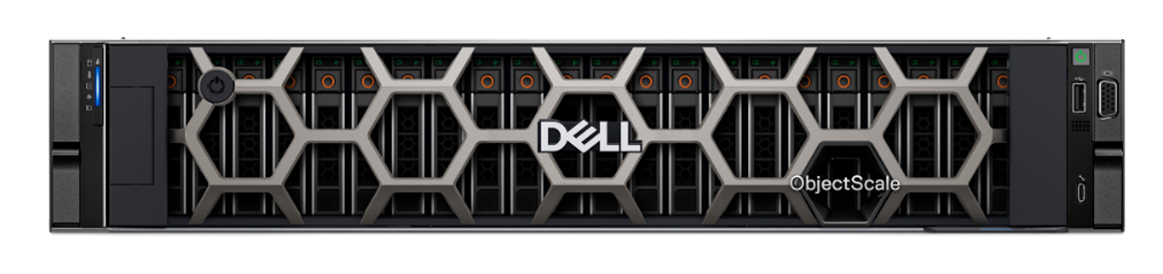
As Dell’s highest-performing object storage platform to-date, the new XF960 delivers up to 300% more read throughput, 42% more write throughput, plus 75% lower read and 42% lower write response times than the previous-generation EXF900.

The XF960 scales effortlessly from small clusters to large enterprise deployments, maintaining performance and manageability throughout. It also introduces advanced data efficiency features, including five user-configurable compression modes—LZ4, Zstandard, and Deflate among them—allowing for up to a 9:1 compression ratio on certain workloads.

Enhancing its S3 protocol compatibility, the XF960 supports push-based event notifications, up to three times faster object listing, S3FS file system mounting, and seamless integration with the latest AWS SDKs, improving both data access and developer productivity.

Designed for flexible integration, the XF960 accommodates the expansion of existing ECS environments, and is initially supported with the new ObjectScale 4.1 code which dropped last week (8/12/25).

As compared to the EXF900, the XF960 features up-rev’d hardware, including a 2RU PowerEdge R760 chassis, dual Intel Sapphire Rapids CPUs with 32 cores, 256GB DDR5 memory, and support for NVMe drives ranging from 7.68TB to 61.44TB. It also includes 100GbE front-end and back-end NICs, dual 1400W power supplies, and S5448 switches.

  EXF900 XF960
CPU Dual Intel Cascade Lake 24 Cores (165 W) Dual Intel Sapphire Rapids 32 Cores (270W)
RAM 192GB RAM per node, installed as 12x16GB DDR4 RDIMMs 256GB RAM per node, installed as 16x16G DDR5 RDIMMs
SSDs

(NVMe)

3.84TB ISE

7.68TB ISE

15.36TB TLC ISE

61.44TB QLC ISE

12 and 24 drive configurations

7.68TB TLC ISE

15.36TB TLC SED FIPS

30TB QLC ISE

61.44TB QLC ISE

6, 12 and 24 drive configurations

Front End NIC 25GbE, 100GbE 100GbE
Back End NIC 25GbE, 100GbE 100GbE
Power Dual 1100W PSUs Dual 1400W PSUs
Back/front-end Switches S5248 S5448

For existing ObjectScale all-flash customers, while it is technically possible to intermix EXF900 and XF960 nodes, it is not recommended due to performance limitations. Mixed clusters will operate at EXF900 performance levels. That said, the  next ObjectScale release, v4.2, will introduce improvements for mixed environments.
ObjectScale 4.1

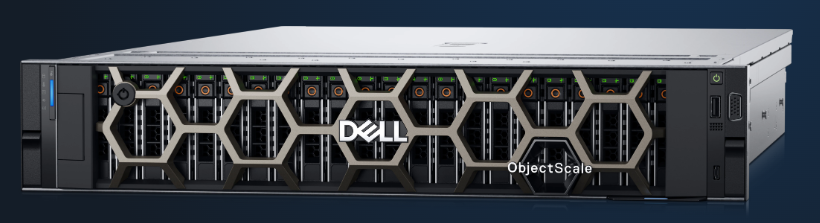
Hot off the press comes ObjectScale version 4.1 – a major release of Dell’s enterprise-grade object storage platform. As a foundational component of the Dell AI Data Platform, ObjectScale 4.1 delivers enhanced scalability, performance, and resilience that’s engineered to meet the evolving demands of AI-driven workloads and modern data ecosystems.

This release is available as a software upgrade for existing ECS and ObjectScale environments, and the core new features and functionality introduced in this ObjectScale 4.1 release include:

Storage Efficiency and Operational Experience

On the storage efficiency and operation experience front, ObjectScale 4.1 introduces support for multiple compression modes including LZ4, Zstandard, Deflate, and Snappy, configurable via both the UI and API. This flexibility allows admins to fine-tune compression strategies to balance performance, cost, and workload characteristics.

Post-upgrade to ObjectScale 4.1, the default algorithms are updated to LZ4 for AFA appliances (EXF900 and XF960) and Zstandard for HDD appliances (EX300, EX3000, EX500, EX5000, X560). Storage admins can change the algorithm at any time via the UI or API, based on workload or use case.

Improved garbage collection throughput enables faster reclamation of deleted capacity. Enhanced monitoring, alerting, and logging tools provide greater visibility into background processes, contributing to overall cluster stability.

An updated dashboard offers refined views of user, available, and reserved capacity. Automated alerts notify administrators when usage exceeds 90%, indicating a transition to Read-Only mode for the affected Virtual Data Center (VDC).

New port-level bandwidth controls for replication traffic allow for more predictable performance and optimized resource allocation across distributed environments.

Security and Data Protection

Within the security and data protection realm, ObjectScale now provides support for Self-Encrypting Drives (SEDs) with local key management via Dell iDRAC. This ensures hardware-level encryption and secure, appliance-local key handling for enhanced data protection.

TLS 1.3, the latest version of the Transport Layer Security protocol, is also supported in ObjectScale 4.1. This upgrade delivers stronger encryption, faster handshakes, and the removal of legacy algorithms, improving both control and data path security.

Expanded Capabilities for Modern Workloads

ObjectScale 4.1 now offers up to 3x faster object listing performance in multi-VDC environments. This enhancement improves data browsing and discovery, with better handling of deleted metadata and validation of Untrusted Listing Keys.

Through webhook-based APIs, ObjectScale can now push real-time notifications to external applications when events such as object creation, deletion, or modification occur—enabling responsive, event-driven architectures.

Support for S3FS in 4.1 allows users to mount S3 buckets on Linux systems as local file systems. This simplifies access and management, particularly for legacy applications that rely on traditional file system operations.

On the integration front, ObjectScale 4.1 is compatible with the latest AWS SDK v2.29, so Java developers can immediately use new S3 features and performance fixes in their applications, and build cloud-native applications with full access to modern AWS features and APIs.

The following hardware platforms are supported by the new ObjectScale 4.1 release:

Gen 2 systems U480E, U400T, U400E, U4000, U400, U2800, U2000, D6200, D5600, D4500
Gen 3 systems EX3000, EX300, EXF900, EX5000, EX500
Gen 4 systems X560, XF960

Note that upgrading to ObjectScale 4.1 is only supported from ECS 3.8.x and 4.0.x releases.

In summary, ObjectScale 4.1 represents a strategic advancement in Dell’s commitment to delivering intelligent, secure, and scalable storage solutions for the AI era. Whether upgrading existing infrastructure or deploying new systems, this new 4.1 release empowers organizations to meet the challenges of data growth, complexity, and innovation with confidence.